
The True Costs of Agriculture
Agriculture feeds us – but today’s system consumes the future. Hidden costs strain soils, water, climate, and health.
Hidden Costs – Made Visible
Behind every seemingly cheap product lie real costs. They don’t appear on price tags – but in groundwater pollution, air degradation, biodiversity loss, and the depletion of humus. Society pays them through taxes and the erosion of natural capital that is hard to restore.
Nitrate Pollution
More than 25% of Germany’s groundwater monitoring sites exceed the EU limit. Drinking water purification alone costs over €600 million per year.
Fine Dust & Public Health
Ammonia emissions from agriculture are a major source of particulate matter – linked to more than 400,000 premature deaths annually across Europe.
Loss of Soil
Worldwide, around 24 billion tonnes of soil are lost each year. In Germany, 50% of agricultural soils are affected by erosion – the very foundation of our food production is vanishing.
What Research Reveals
“The invention of ammonia synthesis changed the world – but also the balance of the nitrogen cycle.”
Erisman, J.W. et al. (2008). How a century of ammonia synthesis changed the world. Nature Geoscience, 1(10), 636–639.
“In Europe, nitrogen pollution costs society €70–320 billion per year.”
van Grinsven, H.J.M. et al. (2013). Costs and benefits of nitrogen for Europe and implications for mitigation. Environmental Science & Technology, 47(8), 3571–3579.
“Residues of multiple pesticides are still detected in fruits and vegetables sold across Europe — including substances linked to hormone disruption and neurotoxicity.”
Greenpeace & European Food Safety Authority (EFSA) (2023). Pesticide Residues in Fruits and Vegetables: Annual Monitoring Results. Greenpeace EU, 2023 | EFSA Report 2023.
“Over the last 50 years, mineral and trace element contents in many fruits and vegetables have declined by 20–50%. Modern varieties and depleted soils are contributing factors.”
Davis, D.R., Epp, M.D., & Riordan, H.D. (2004). Changes in USDA Food Composition Data for 43 Garden Crops, 1950–1999. Journal of the American College of Nutrition, 23(6), 669–682. See also Hügel, S. (2023). The Mineral Shift – Why Our Soils and Foods Are Losing Nutrients. mineralienwende.de.
What does the alternative look like?
Regenerative agriculture can turn these costs into values – through humus building, clean water, healthy food, and people who take responsibility.
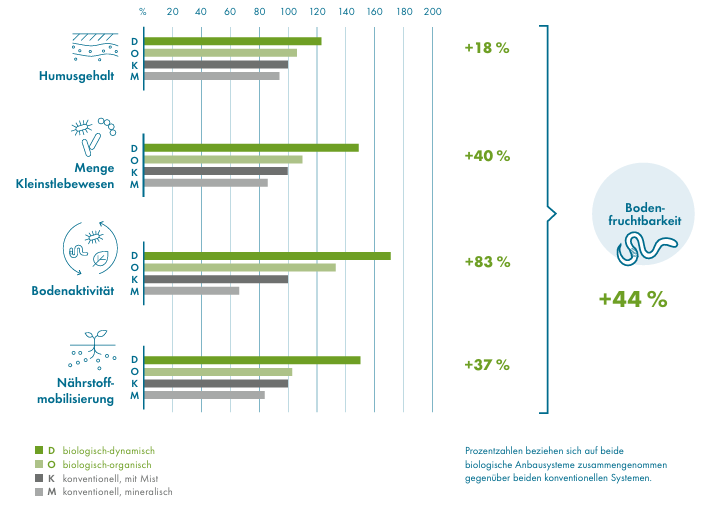
Whether biodynamic or organic, the effects on soil fertility are remarkable. The most comprehensive long-term field trial to date – spanning 45 years – shows: Soil fertility is up to 44 % higher than in conventional farming (regardless of fertilization). In other words: humus content, soil activity, and nutrient availability all increase significantly. See the following FiBL illustration:
→ Learn more about the Living Lab